
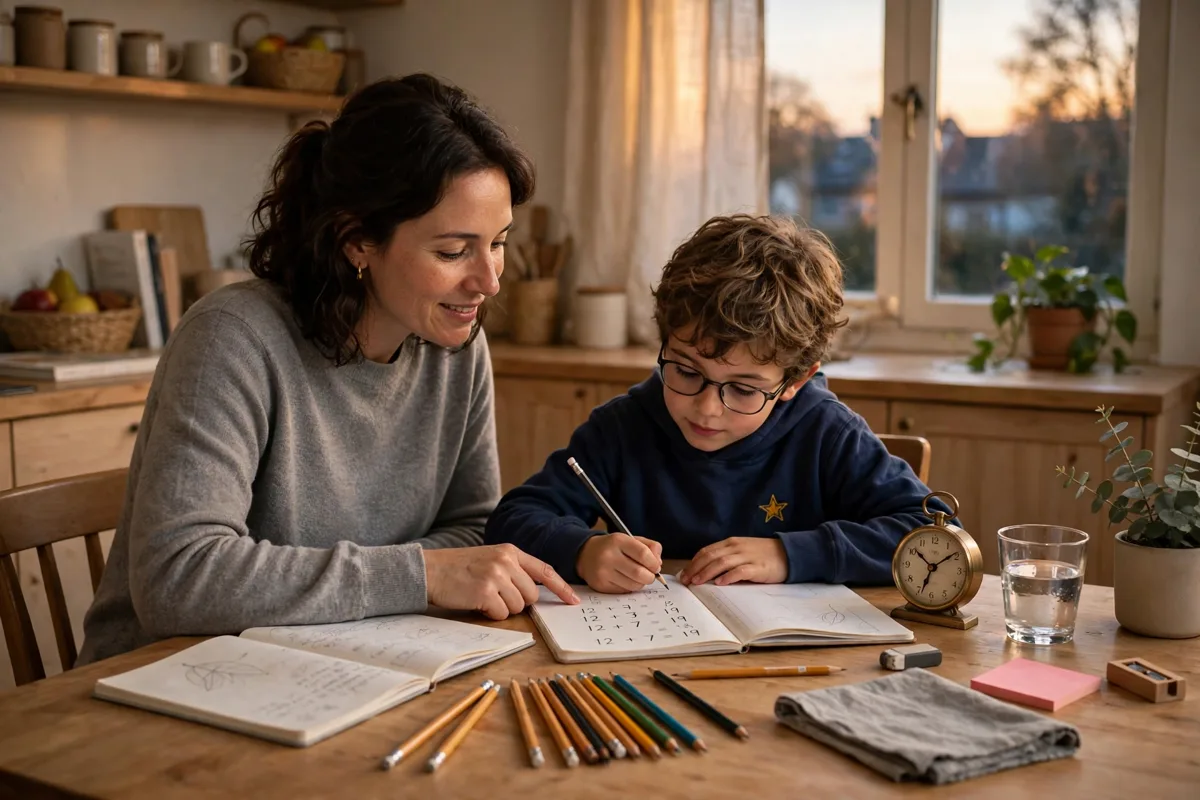
It is half past five, dinner is not ready, and your child is staring at a maths worksheet like it personally offended them. If that scene sounds familiar, the problem is rarely laziness. Most children resist homework because it arrives at a random time, in a random place, with no clear start or finish. A steady homework routine fixes that. When the time, place and steps stay the same every day, homework stops being a daily negotiation and becomes just another part of the evening, like brushing teeth.
This guide walks you through building a homework routine for kids that actually holds up on busy school nights. You will set a start time, prepare a focus-friendly spot, and teach your child to start, work and finish without a battle.
Why a Homework Routine Works Better Than Willpower
Children have a limited supply of decision energy, just like adults. When every evening starts with questions about when, where and how long, that energy runs out before the first worksheet is opened. A routine removes the decisions. The brain learns that four o’clock means books out, and starting gets easier week by week.
Routines also give children a sense of control. A child who knows exactly what happens after snack time feels calmer than a child who gets ambushed by homework at unpredictable moments. That calm is worth as much as the finished assignments.
Start small. You do not need a colour-coded chart covering the whole evening. One fixed start time and one fixed place are enough to begin.
Step One: Pick a Start Time and Protect It
Choose a start time that fits your family’s real life, not an ideal one. Right after school works for some children, while others need an hour of play and a snack before they can concentrate. Either is fine, as long as the time stays consistent on school days.
Agree the time with your child instead of announcing it. Children follow routines they helped design far more willingly. Our guide on how parents can teach children time management skills shows simple ways to make time visible for younger children, such as timers and picture schedules.
Protect the slot like an appointment. Football practice and birthday parties will sometimes clash, and that is normal life. The rule is simple: homework moves earlier on those days, it does not disappear.
Step Two: Set Up a Homework Spot That Invites Focus
The homework spot does not need to be a separate room. A consistent corner of the kitchen table works well, as long as it is the same place every day and supplies live within reach. Keep pencils, paper, a ruler and a rubber in a small box so nobody wastes ten minutes hunting for a sharpener.
Remove the obvious distractions. Phones charge in another room, the television stays off, and siblings who have finished play somewhere else. If your child struggles to settle, our article on how students can minimize distractions with focused study environments has practical fixes that work in small homes too.
Lighting matters more than furniture. A bright, comfortable seat near natural light helps tired eyes, and a glass of water on the table prevents the classic string of kitchen trips.
Step Three: Start With a Two-Minute Launch Ritual
Starting is the hardest part, so make starting tiny. A launch ritual is a short, fixed sequence: sit down, open the school diary, read the tasks aloud, and pick the first one. Two minutes, every day, in the same order.
Many families add one calming minute before the books open. A few slow breaths or a quick stretch helps children switch from play mode to work mode. You will find similar ideas in our piece on ways to incorporate mindfulness and focused attention in daily activities.
Let your child choose which task to start with. Easy first builds momentum for some children, while others prefer to clear the hardest task while their mind is fresh. Both approaches work.
Step Four: Break the Work Into Small, Visible Wins
A page of 20 maths problems looks endless to an eight-year-old. Cover the page with a blank sheet and reveal five problems at a time, and the same work suddenly feels manageable. Visible progress keeps motivation alive far better than promises about the weekend.
Use a simple checklist on paper. Children love ticking boxes, and each tick is proof that the session is moving. This habit also builds independence, which is the long-term goal behind our strategies for teaching responsibility and time management to children.
Build in short breaks. Five minutes of movement after every 20 to 25 minutes of work suits most primary school children. Set a timer for the break as well, so returning to the table is not another argument.
Step Five: Use Active Recall for Study Homework
Some homework is practice, and some is learning new material for a test. For the second kind, re-reading notes is the weakest method your child can use. Testing memory works far better, even when it feels harder.
Ask your child to close the book and explain the topic to you in their own words. Gaps in the explanation show exactly what to revise. Our guide to active recall and why testing beats highlighting explains the method in plain language, with examples for different ages.
Keep it light. Two or three questions over dinner turn revision into conversation instead of a second school day.
Reading Homework Counts Too
Reading is often the first homework task schools set, and the easiest one to let slide. Treat it like any other part of the routine: same time, same spot, book finished before screens.
For younger children, reading aloud together builds vocabulary and confidence faster than silent reading alone. Our article on reading aloud to children covers the benefits and shows how to build a daily reading habit that children actually ask for.
Older children can read independently, but a two-minute chat about the chapter keeps you connected to what they are reading.
A Real Example: How One Family Fixed Their Evenings
Consider Sara, a mother of two in Manchester, whose evenings used to end in tears over unfinished worksheets. Her son, aged nine, did his homework at a different time and place every day, usually starting after seven when he was already tired. Homework took over an hour, most of it spent arguing.
Sara changed only three things. Homework moved to half past four, straight after a snack. A small supply box appeared on the kitchen table. And every session started with her son reading his task list aloud and choosing the first job himself.
Within three weeks, the same homework took about 30 minutes, and the arguments had mostly stopped. Nothing about the schoolwork changed. The routine around it did.
When the Routine Falls Apart
Some days will still go wrong. A tired, hungry or upset child cannot concentrate, and pushing harder rarely helps. On those days, do the minimum together, note what caused the wobble, and restart the routine tomorrow without a lecture.
If homework regularly takes far longer than the school suggests, or your child shows real distress, talk to the teacher. A routine helps with habits, but it cannot fix work that is genuinely too hard or too much.
Review the routine every school term. As children grow, the start time, the break pattern and the level of supervision all need adjusting.
Small Steps, Calmer Evenings
You do not need a perfect system. Pick a time, prepare a spot, start with a tiny ritual, and let small wins do the heavy lifting. Within a few weeks, the homework routine runs itself, and your evenings get quieter for everyone.
